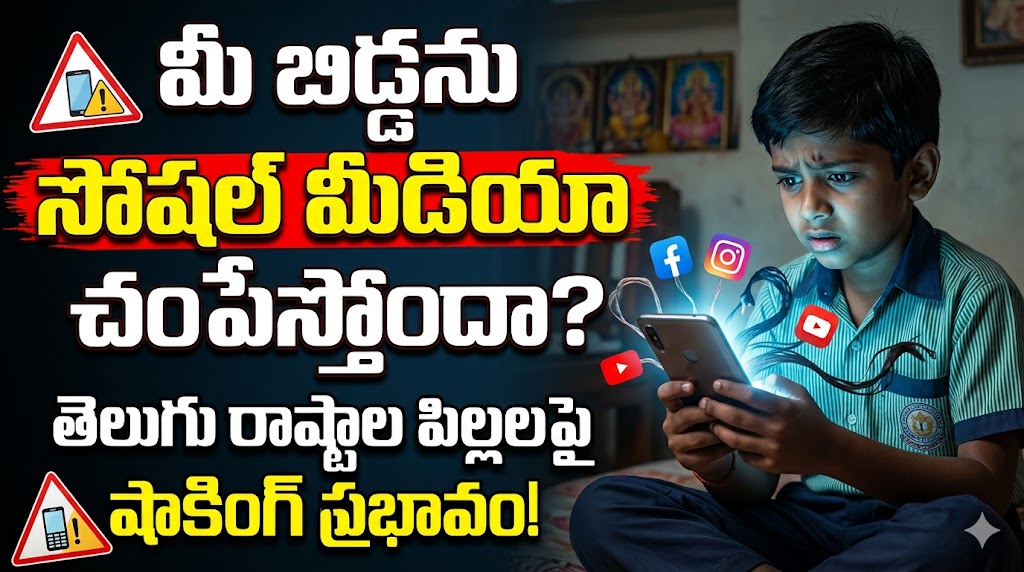
This report is the result of conversations with over three dozen parents, school teachers, child psychologists, and cyber safety officers across the Telugu states over a period of two months. We did not set out to scare anyone. We set out to understand a pattern that has become impossible to ignore.
What we found should concern every family.
Part 1: The Unseen Pattern
In February this year, a teacher at a well-known school in Guntur noticed something that stopped her mid-sentence. A boy in Class 8, usually quiet and attentive, was staring at his desk with a vacant expression. When she called his name, he did not respond. When she walked closer, she saw his lips moving slightly, as if he was talking to someone. But there was no one there. He was mouthing dialogues. Dialogues from a YouTube video he had watched the night before.
This is not a story about one child. Over the course of our investigation, we heard similar accounts from teachers in Vijayawada, Visakhapatnam, Warangal, and Hyderabad. The details varied, but the core observation was the same: children are bringing the language, gestures, and attitudes of online video content into their real lives. And a significant portion of that content glorifies aggression, disrespect, and lawlessness.
of children aged 14 to 16 in Telangana are proficient smartphone users. Of these, 82.5% use their phones primarily for social media and entertainment, not education.
Part 2: The "Gangster" Pipeline — How It Works
Our investigation focused on understanding how a child who starts by watching innocent content—cartoons, cricket highlights, comedy skits—ends up consuming videos that celebrate criminal behavior.
We created a fresh YouTube account and used it as a typical teenager might. Here is what happened over just three days:

Day 1, Hour 1: Watched two Telugu comedy skits. Recommendations showed more comedy mixed with prank videos.
Day 1, Hour 2: Clicked on a "Rowdy Hero Entry Scene" compilation with 4.7 million views.
Day 2: Feed changed noticeably. "Attitude" content appeared—videos titled "Don't Mess With Me" and "Savage Replies to Teachers."
Day 3: Recommendations included videos glorifying local gangsters, street fights set to loud music, and young men using threatening language.
At no point did we search for "rowdy," "gangster," or "fight." The platform's recommendation system determined this content would keep us watching longer. And it was correct.
This is the "Gangster Pipeline"
It is not a conspiracy. It is a business model. Content that triggers strong emotions—anger, fear, excitement—keeps users on the platform. Longer watch time means more advertisements. More advertisements mean more revenue. The child's developing mind is the raw material in this transaction.
Part 3: What the Numbers Tell Us
While individual stories are powerful, we also examined available data to understand the scale of the issue.
In rural Telangana, over 75 percent of teenagers can operate a smartphone, and entertainment dominates over education.
Nationwide surveys of urban Indian parents reveal that two out of three parents believe their child is addicted to social media, OTT platforms, or online gaming. Nearly 60 percent report increased aggression, impatience, and lethargy in their children as a direct result.
Over 60 percent of parents have observed their children becoming more aggressive or irritable due to online trolling and harassment. Many report disturbed sleep patterns and difficulty concentrating on studies.

Part 4: When the Screen Is No Longer Enough
Our investigation also documented the most tragic outcomes of unchecked digital addiction.
In Visakhapatnam, a 20-year-old engineering student fatally assaulted his mother after she restricted his access to online gaming by hiding his laptop.
In Hyderabad's Madhapur, a 23-year-old college student took his own life after significant financial losses through online gaming applications.
In the Sri Sathya Sai district, a young man addicted to online games and facing financial ruin ended his life.
In Visakhapatnam, a 14-year-old boy died by suicide after being reprimanded for excessive gaming.
These incidents are investigated and documented by local law enforcement. They are not rumors.
of urban Indian parents believe their child is addicted to social media or online gaming. Nearly 60% report behavioral changes including aggression and impatience.
Part 5: Why This Is Happening — The Economics of Attention
Social media platforms and video-sharing sites do not charge users a fee. Their revenue comes from advertising. The more time a user spends on the platform, the more advertisements they can be shown. This is the "attention economy."
The software that decides what videos to show next is called a recommendation algorithm. Its sole objective is to maximize watch time. Over years of refinement, these algorithms have learned that emotionally charged content keeps people watching longer than calm, neutral content.
For a child whose brain is still developing—the prefrontal cortex, which governs impulse control, does not fully mature until the mid-twenties—this creates a perfect storm.
Part 6: What Parents Can Do — Practical Steps
Based on our conversations with child psychologists, cyber safety experts, and educators, here are practical steps any parent can take:
- Remove Devices From Bedrooms at Night — The single most effective step. Charge all devices in a common area overnight.
- Understand What They Are Watching — Spend 10 minutes sitting with them while they scroll. Ask neutral questions: "Who is this person?" "What is this video about?"
- Teach Them How the System Works — Explain: "These apps make money when you keep watching. They show you things that make you angry or excited because that makes you watch more."
- Provide Real-World Alternatives — Evening walks, traditional games, storytelling, cooking together. Boredom is the space where creativity grows.
- Speak Telugu at Home — Much harmful "gangster" content is in Hindi or English. Telugu provides a stronger cultural anchor.
- Know the Warning Signs — Increased secrecy about phone use, irritability when asked to put it down, using language or gestures that seem out of character.

Conclusion: The Choice Belongs to Families
This investigation began with a simple question: Why are children in our communities behaving in ways that seem disconnected from the values we try to teach them?
The answer is clear. A global system of content creation and algorithmic distribution, designed to maximize profit through attention capture, is actively shaping young minds in Andhra Pradesh and Telangana. This system does not care about our culture, our language, or our children's futures. It cares about watch time.
Governments can pass laws. Schools can implement digital literacy programs. Both are necessary. But the daily work of protecting a child's mind happens at home. It happens when a parent decides to ask what their child is watching. It happens when a family chooses conversation over screens at dinner.
The phone in your child's hand is a powerful tool. It can educate and connect. But left unguided, it can also reshape a child's understanding of respect, power, and what it means to be a good person. The choice of what it will be rests with the adults in the room.